
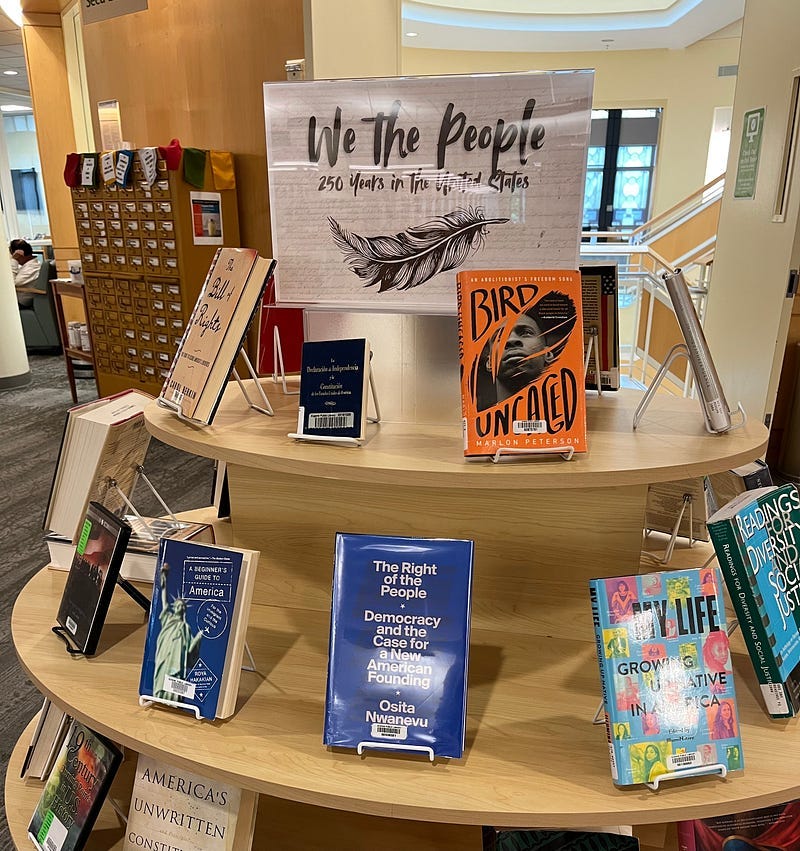
The curving staircase opens out almost directly onto the librarians’ recommended book display: “We the People, 250 Years in the United States”.
The large, tiered bookcase, shaped like a short, wide Christmas tree, features unsung heroes and under-told stories on each shelf. It’s a roll call of sorts, but these are the names that don’t get called in mainstream media or enough academic curricula.
Our shared heritage isn’t only Anglo and Christian. American history is multicultural and multilingual. Our celebrations should be too. And local librarians are platforming marginalized voices in order to tell our whole story.
This Independence Day, we celebrate 250 years of freedom from Great Britain. We celebrate our independent statehood. But the MAGA administration and conservative school boards across the country are not celebrating those who actually created this country as we’ve come to know it and live it. They don’t want to talk about the Native American genocide or chattel slavery. They don’t want students learning how many people died building our infrastructure and industry, how many people were killed in every war, conflict, textile factory fire, coal mine collapse, or natural disaster. This administration is actively trying to erase these histories.
The Department of Defense banned 596 books that predictably included anti-racism and LGBTQ titles the administration refers to as “gender ideology extremism” and “divisive concepts”.*
We wouldn’t even know which books the DOD banned were it not for an ACLU lawsuit in which a federal judge demanded the public release of those titles.
It’s not just the military. Public schools across the country continue to ban books by the hundreds, including classics like “To Kill a Mockingbird”, “Beloved”, “Brave New World”, “1984”, and “Fahrenheit 451.”
The PEN America Index of School Book Bans is the most comprehensive attempt to document ongoing book bans throughout public schools in the U.S. It currently lists a staggering 23,000 books banned since 2001.
A public library can’t reach everyone, especially those who don’t want to read about the immigrants who built this country, the colonizers who tried to destroy the sweeping and diverse Indigenous population, or how the modern prison industry perpetuates slavery. But in a town that literally burned crosses on its central hilltop for years, knowledge isn’t just power. Knowledge creates compassion. That compassion can be a reckoning, and that reckoning can be unifying.
Librarians everywhere are trying to supplement our education, circumvent book bans, and broaden our proverbial horizons by spotlighting books like “Lift Every Voice: African American Oratory 1787–1900”, “The Jewish Americans” on PBS Home Video, and “Latino Americans: The 500-Year Legacy That Shaped a Nation”.
Books like “A More Perfect Constitution: 23 Proposals to Revitalize Our Constitution and Make America a Fairer Country”, The “Right of the People: Democracy and the Case for a New American Founding”, and “Bad Mexicans: Race, Empire & Revolution in the Borderlands” are more likely to become banned books than required reading, but librarians are in-house experts; their recommendations are rooted in expertise and experience.
And these experts recommend reading Larry J. Sabato, Osita Nwanevu, and Kelly Lytle Hernández.
At the national level, the semiquincentennial (a new word for most of us) celebration of our 250th anniversary feels like the all too familiar whitewashing of U.S. history. It’s predictably racist in its reductionism.
Our story isn’t just white. And it’s not just celebrities. It is literally millions of non-white unknown people with the same dream, the American Dream for a better life.
What stories do you recommend documenting the Chinese-American experience of building the transcontinental railroad?
What about the incarceration camps for Japanese Americans? Who has read and would recommend “Farewell to Manzanar” or “Citizen 13660”?
What are the best historical nonfiction books about the genocide of the Indigenous people here? The decimation of their population from some 10 million down to an estimated 300,000?
And which history titles best teach us the respective chapters of the slave trade, slavery, resistance, rebellion, abolition, Reconstruction, Jim Crow, and the Civil Rights movement?
Unsung: Unheralded Narratives of American Slavery & Abolition author and professor Michelle D. Commander curated this list of recommended reading on “slavery and memory in the United States.”
The School Library Journal curated this young readers’ list for students learning about slavery. They recommend fiction and non-fiction.
Fiction tells our story too.
Ocean Vuong writes heartbreakingly of Vietnamese and Lithuanian immigrants to the Midwest in his novel “The Emperor of Gladness”.
Louise Erdrich writes about missing and murdered Indigenous women and girls (MMIWG) in “The Round House.”
How much do we know about the young Chinese girls kidnapped and trafficked to San Francisco? I recommend “Three Coins”. Prolific author Dr. Russell Low writes extensively and beautifully about how our shared immigrant histories unite us as Americans.
Our American history isn’t just Lewis and Clark, Paul Revere, and Daniel Boone.
It’s also “The Immortal Life of Henrietta Lacks”, “Killers of the Flower Moon”, and “Solito.”
It’s the history of every girl and woman who died by attempted abortion because an employer, boyfriend, or husband raped and/or abandoned her. “Madame Restell” is a must-read, infuriating exposé.
The American experiment represents the extraordinary idealism and ambition of immigrants, the pure evil of genocide and slavery, the normalcy of child labor, boundless entrepreneurship, ingenuity, bigotry, and resilience.
As you’re considering and creating your own 250th reading list, include resilience and joy.
“How do you build the best anti-racist reading list?,” Oregon Public Broadcasting asked during the pandemic. “Kirby McCurtis, library manager at Multnomah County Library, says it’s important to include Black fiction and stories about Black joy.”
We are a young country, yes. But our history is complex. It is brutal and beautiful. It is painful and creative. And a local library, like most libraries constantly fighting for adequate funding, is still trying to serve its community with stories that reflect our complexity. It is still trying to invite everyone to America’s semiquincentennial party, the Latin word for 250th that most of us are hearing for the first time.
Read about the suffering and the success of so many different communities that truly do make America great.
Your library offers you extraordinary resources.
As if free books in multiple formats and many languages weren’t incredible enough, this library also offers children’s events, hosts world-famous authors like T.J. Klune, and community “listening” opportunities with the new, local independent newspaper.
They offer a Library of Things: “225 different types of items for a total of 750 objects, including more than 200 wifi hotspots, in categories including Arts and Crafts, Baking and Cooking, Games, Musical Instruments, Educational Toys, and Science and Technology.” This includes tools, toys, cameras, sewing machines, and robotics kits.
Libraries of Things help patrons explore new hobbies, develop new skills, and reduce consumption all while saving money.
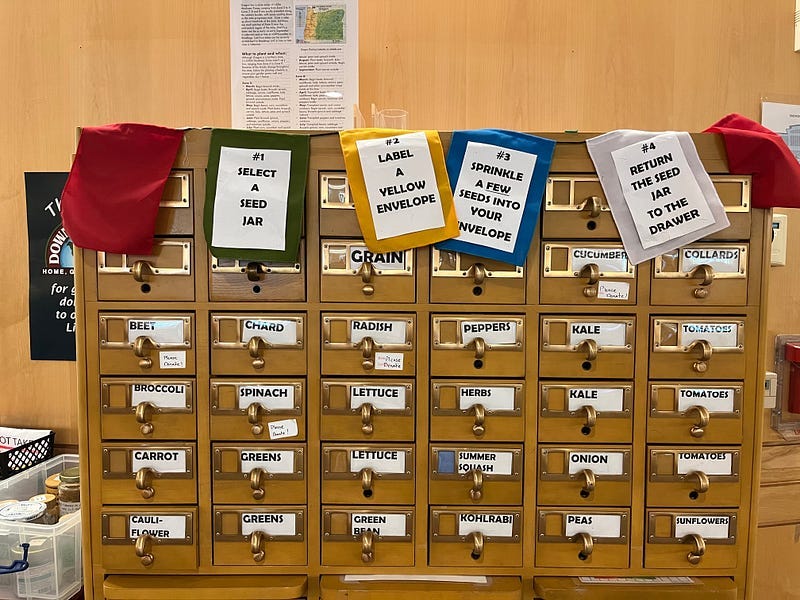
This local library is also a seed library for all gardeners.
And, as is often pointed out, the public library is one of the few remaining spaces where you do not have to spend money to be there.
During extreme weather, public libraries are one of the few free spaces where people can escape dangerous heat and life-threatening cold.
Libraries shouldn’t be the only place with free public restrooms.
All local libraries should be line items in state budgets. They shouldn’t have to campaign for local option levies every two to five years.
Until then, and for all of time, patronize your local library. Check out your librarians’ recommendations. Attend events that interest you or could expand your child’s world. Use your library card on Libby to listen to audiobooks without having to subscribe to Audible.
As we celebrate our 250th anniversary as an independent nation, let’s also celebrate one of our greatest institutions, and the unsung hero authors they recommend.
And leave your favorite book titles in the comments. What should everyone be reading to celebrate 250 years of American history, complexity, diversity, success, and opportunity?
*A January 2025 Executive Order claimed that DEI policies and programs within the military “actions undermine leadership, merit, and unit cohesion, thereby eroding lethality and force readiness.”
In a world full of violence, perhaps governments should look at ways to “erode lethality” as a peace-building endeavor.
Out of curiosity: what is the definition of "Black joy"? That would make it easier to find relevant material.