
“The world is only as free as we allow our artists to be,” music industry legend Rick Rubin wrote in “The Creative Act.”
“Hold my fresh coconut water.” Bad Bunny took to the biggest stage in the entertainment world and used his own artistry to showcase that we’re not all free until every agriculture laborer, construction worker, barber, taco stand owner, and nail tech is free too.
When global systems are rigged, not everyone gets to “fulfill their ultimate purpose”—no matter how hard you work. Bad Bunny platformed that. By calling out the corruption and division that keep us oppressed, and fighting each other instead of together, by making advocating for everyone a party, he proved how powerful art can be.
Good art makes us feel. Great art makes us think. Inspiring art generates more art. Transcendent art unifies strangers with a shared experience.
Bad Bunny gave us every level of art in 13 minutes.
Good Art
Art can make anyone feel anything. The most hardened cynic can soften before unexpected beauty, cry listening to Ave María, watching a Haka, or looking at a Rothko painting. The most sheltered person can be stunned into a new political compassion standing before “Guernica” or burst into tears listening to Billie Holiday’s “Strange Fruit”, Sam Cooke’s “A Change Is Gonna Come”, or U2’s “Sunday Bloody Sunday.”
Edward Hopper’s paintings often evoke loneliness while Van Gogh’s “Café Terrace at Night” can spark an exciting dépaysement for a place we’ve never been or a nostalgia for a bygone era.
Good art is emotive even if we can’t quite articulate our feelings. We say generalized things like, “it was moving” or “I can’t explain why I like it so much.” What moves us is widely subjective and can be deeply private but it doesn’t have to pass any purity tests or academic panel to prove its worthiness. Good art doesn’t require words, verdict, or consensus. If you feel it, that’s art. That’s enough. And that’s beautiful.
Even before Bad Bunny took to the field, in the months since he was announced as the halftime headliner, people all over the world felt overjoyed. By the time he emerged in the sugarcane field, pointed at the camera and told us all not only to never stop believing in ourselves, but to never underestimate ourselves, there wasn’t a dry eye in the openminded world. In the week since, millions of people keep posting their reaction videos. From little kids of every ethnicity dancing to Latina moms swooning over Ricky Martin to grandparents tearing up over the sentiment of the Debí Tirar Más Fotos lyrics and hearing traditional salsa, Bad Bunny’s art moved us. That’s undeniably good art.
Great Art
Great art makes us think. It fosters discussion and engagement. It teaches us, and, if we’re curious enough, open enough, we can learn from it.
Bad Bunny didn’t just sing and dance, he layered lessons. And we can’t stop analyzing the symbolism in his lyrics, performance, props, and setting.
He reminded the world about the colonial history of agricultural slavery and the failure of post-hurricane disaster relief in an American territory. He warned us against the inevitable displacement and poverty of indigenous people that always follows the resortification of tropical islands. He honored and recognized a now-famous Newyorican businesswoman like Toñita, for fighting decades of gentrification in Brooklyn, as well as the working people and non-celebrity professions that make up daily life in Puerto Rico.
His visual storytelling was great art. People in bars and bookstores and living rooms all over the world joined people all over the internet analyzing every story he told with every symbol he used, just like we still do with French Romantic Eugène Delacroix’s “Liberty Leading the People”, Frida Kahlo’s self-portraits, and Mexican muralist José Clemente Orozco’s revolutionary paintings.
People all over the world learned more about Puerto Rico’s history, culture, and daily reality in 13 minutes than we do from many 20-minute Ted Talk topics.
Though it often does, great art doesn’t have to create controversy to prompt great dialogue and deep dives.
Of course some people didn’t like it, didn’t “get it”, or even hated it. But pay attention to their actual critiques. Are they just whining? Or do they have substantive criticisms? If they don’t, and we’re hearing all the greatest hits of logical fallacies, just don’t engage. If the complaints are ad hominem attacks, straw men arguments, double standards, moral panic, slippery slope, and hasty generalizations, there’s no constructive in-depth discussion to be had. Just keep dancing.
Plenty of naysayers hated Hamilton too, any for many of the same reasons. They had no interest in learning from that Puerto Rican masterpiece either.
But you can gain knowledge from great art instead of trying to legitimize ignorance and hatred. Spend “your one wild and precious life” experiencing and learning from great artists.
Inspiring Art
Inspiring art is generative, even if it’s initially just people replicating or reiterating the original artwork. Think of all the iterations, many comedic, plenty with cats, of “The Mona Lisa” or “The Girl with the Pearl Earring”, or “The Last Supper.”
The Simpsons have iterated and incorporated countless famous artworks from “The Creation of Adam” and “The Birth of Venus” to “The Persistence of Memory” and “American Gothic.”
Art that keeps thriving in our collective imagination for centuries isn’t just enduring, it flirts with immortality the longer it keeps inspiring more art.
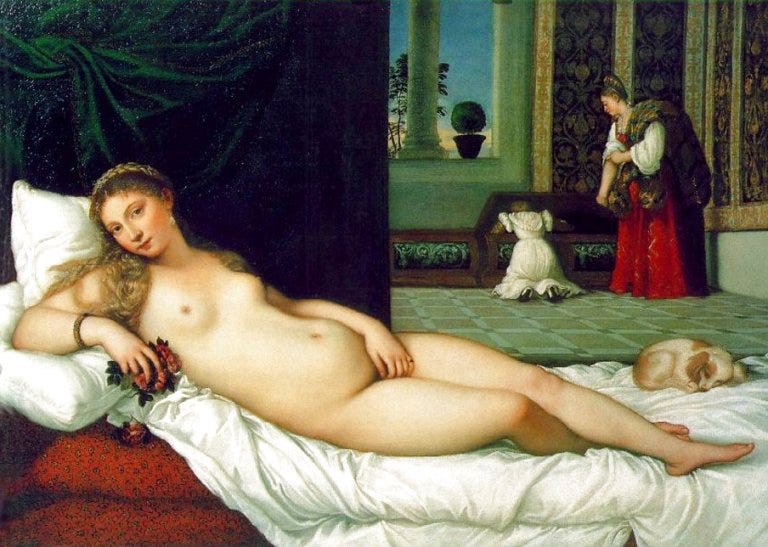
One of the most famous sequences of inspirational torch-passing among painters was a particular succession from Titian to Manet to Gauguin. Their reclining nudes gazing at the viewer change role, location, and race but the key elements remain. The Roman goddess became a Parisian courtesan who became a Tahitian girl.
What we will see in the years and maybe even generations to come will be, yes, more reenactments and reiterations of Bad Bunny’s concert itself. But we will also see new musicians reimagine their own key-element symbolism and messaging into their performances and videos. Perhaps the sugarcane will turn into cotton fields or coal mines. Maybe the blackouts will become Flint’s dirty water. We will see new unique details like the Flor de Maga and the pink casitas and the pavas of other cultures and we’ll learn about the jíbaros and apagones we might otherwise know little or nothing about.
As we saw Beyoncé represent the segregated pools drained after Black people tried to use “white” pools and the Deep South’s post-Hurricane Katrina devastation in her groundbreaking “Formation” video, we will see more musicians champion their communities with their own defining symbols and distinctive stories.
Artists have always found creative ways to depict injustice and inequality, to fight for social and political change. They always will. The exceptionally talented visionary artists depict oppression with integrity and beauty, to inspire us to fight together.
Right now, many people are just reenacting favorite moments from Bad Bunny’s concert in the comfort of their living rooms. Other people recreated the entire choreography within two days with props from their work, like the staff of Las Gaviotas, a Peruvian restaurant whose outstanding video instantly went viral.
Some artists have already been inspired to create new art. Painter Sarah Kraning says “sound is color.” And she painted what Bad Bunny’s DtMF looks like to her.
Keep enjoying this multigenerational, multicultural, multi-genre afterparty as long as it lasts. It’s been an incredibly fun and bonding global sensation. But we also get to look forward to all the creative ways new musicians will keep symbolizing their own history, culture, and visions for a better future.
Transcendent Art
Transcendent art unites people. That transcendency requires no training. The most specialized expert will largely have the same experience as the most uninitiated novice. Regardless of demographic or distance, transcendent art can overwhelm anyone, rich or poor, young or old, unifying people by giving them a shared experience that they cherish for the same reasons.
What did we all love about Bad Bunny’s performance so much? Everyone is still reeling from the same ride. We can still feel the energy, the vibrancy, the openness, the celebration, the joy, and the message of unity. We were invited into someone’s life, their culture.
Transcendent art is more than fun trends. It captures more than our attention for a moment, it speaks to us.
Yes, the NFL chose the most visible Latin star in the world to expand their market by targeting Latino and international audiences. But their economic motivation didn’t change the experience that people from Canadians to Norwegians to Brazilians shared.
People of every age, gender, nationality, and ethnicity posted videos of themselves smiling, shrieking, crying, jumping up and down, cheering, and dancing. They took to the internet to tell the world how they were feeling.
There are few cultural phenomena that unite strangers in a shared experience, transcending our differences. Nothing has created such an internationally shared experience like the Bad Bunny concert since Covid. A global pandemic was the last “cultural phenomenon” that overwhelmed us all equally. Regardless of income, lifestyle, or location, all of our lives screeched to a halt. (Income inequality, marginalization, and power differentials, however, drastically determined how quickly or how fully, if at all, people were able to recover.)
Sometimes, a quarantine catastrophically democratizes the human experience. This time, the democratization was a gorgeous moment in history. Song, music, dance, and symbolism transcended differences and inspired a joyful unity.
One man reignited something radiant but perhaps dormant in all of us. For most, it was joy and hope. For a seething minority, it was racism, fear, and jealousy unsuccessfully disguised as patriotism.
For some, the massive international reactions might seem exaggerated or hyperbolic but the near universal praise for his message isn’t. Sure, “San Benito” is unduly superlative but the “King of Latin Trap” continued and elevated one of the most important conversations we can have as people. And he invited the whole world, in any language to keep talking about oppression, opportunity, and community.
Bad Bunny’s joyful, allegorical halftime performance made us feel, think, create, and celebrate together. That’s art on every level.
Feel free to share your bitter disagreement, joyful agreement, or hope for the future in the comments. Or click here to watch Bad Bunny’s concert again.