
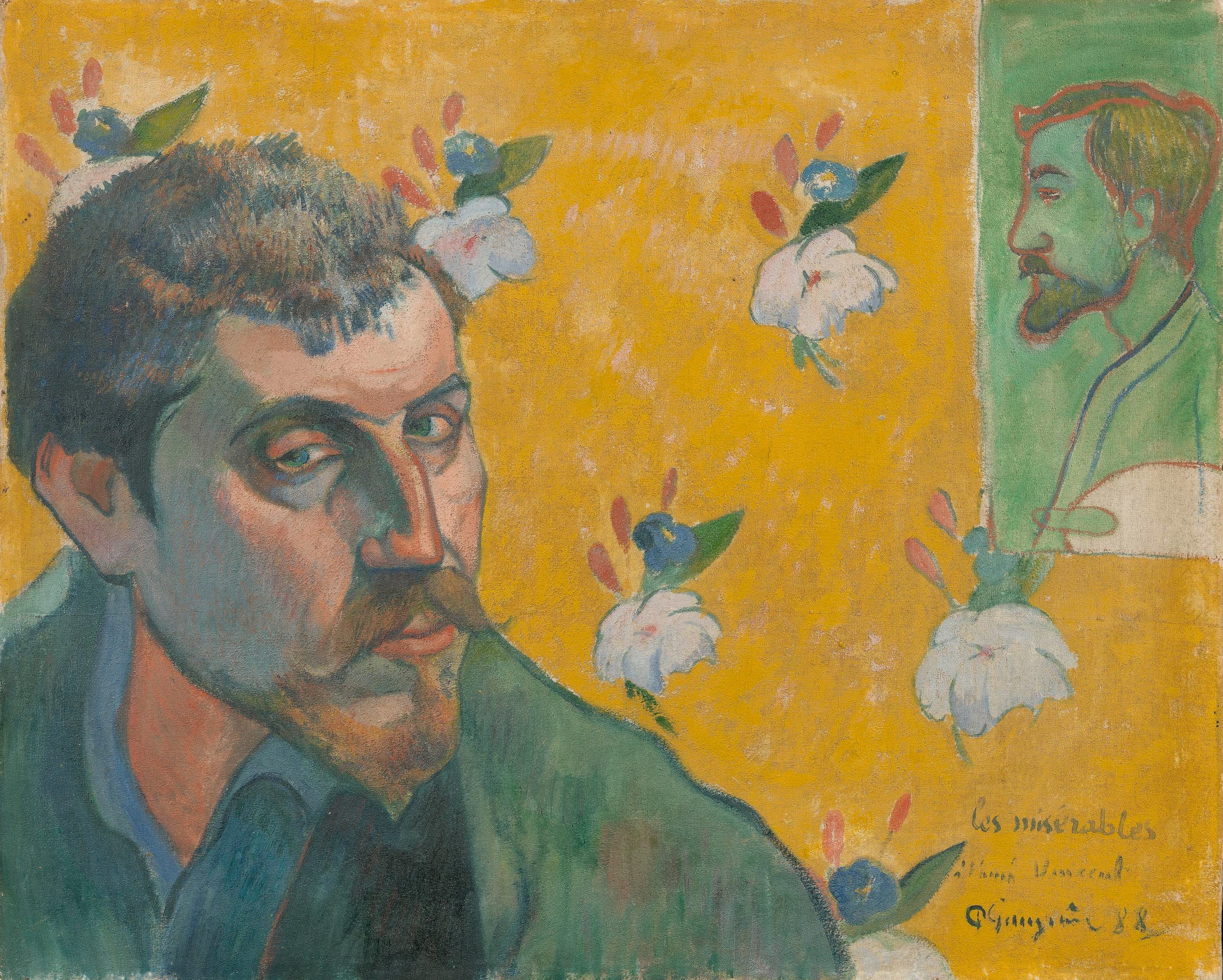
When the annual International Film Festival (FIC) in Monterrey, Mexico featured France as its guest country, the movie I most wanted to see was “Voyage to Tahiti”.
We followed Paul Gauguin, as he had followed Pierre Loti, to a fictionalized and exoticized Tahiti where pubescent girls are cast as fully sexualized adult women, outsiders are mostly welcomed into the fold, and the entirety of another culture exists for your island-themed inspiration.
Imperialist in its imaginings, Gauguin’s obsessive artistic endeavors consume people and place only to reproduce them in oil paint and block print. Which is not to say that his art is singularly colonialist but the movie about his art is. It predictably relied on enduring and marginalizing tropes.
This biopic distills Gauguin’s syphilitic promiscuity down to one mostly monogamous, made-for-the-movies love story. The writers flipped the script and portrayed him as the misunderstood husband of unsupportive wives, the unappreciated hero who died, as all the Great Starving Artists do, in penniless obscurity.
He abandoned his Danish wife and all five of their children in Paris, but that is reframed as her lack of faith in his talent and potential. His hungry children are briefly depicted with minimal compassion as they freeze in a filthy, unheated apartment during the winter.
That his Tahitian child bride leaves him for a boy her own age is a betrayal designed to pain us too. It is lamented as a May-December romance that failed to last. That the actress appears much older than the 13-year-old he was rumored to have taken as the first of three teenage wives is immaterial to the tale of the tormented genius left to languish without an official breakup or even a last goodbye. As a librarian friend of mine says, Le Sigh.
But what about his art, you ask?
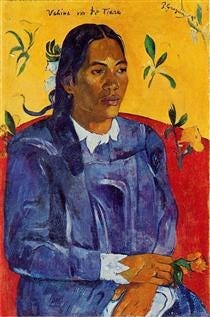
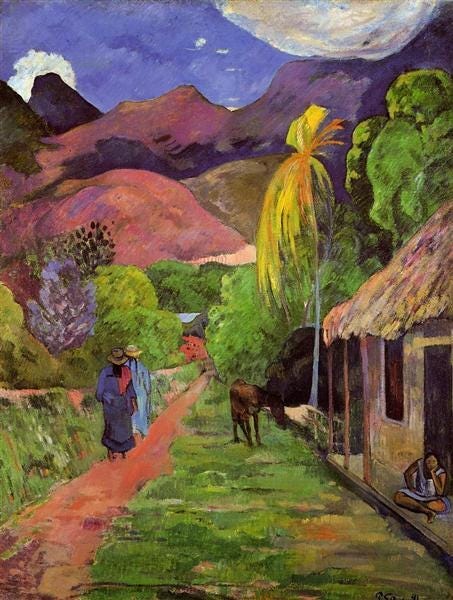
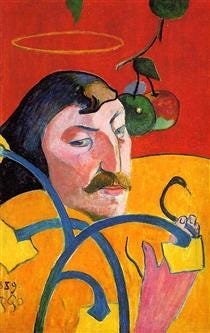
Much of Gauguin’s paintings are vibrant pastorals and many of his portraits are of clothed women. (Note to self: read more about cloisonnism and Synthetist style.) But the movie’s soft treatment of our suffering-for-his-art hero perpetuates the way we always justify famous artists’ transgressions, minimizing the suffering of their loved ones while maximizing the importance of their art.
Gauguin’s life and his paintings highlight three things that never seem to change in art — regardless of the artist, the era, or the medium.
“Artistic” Nudity is Disproportionately Female. Be it sculpture, painting, music videos, or movies, women are disproportionately nude while the typically older and implicitly wiser male counterparts are fully clothed and in control of scene and plot. Now, of course, not all nudity objectifies women. But not all nudity is art. And not all “art” is artistic.
Assholes Get a Pass If They’re Artists. Regardless of their treatment of the people in their lives, artists, typically male, are revered in the retrospective of their lives and their work irrespective of their misogyny, pedophilia, or general misanthropy. Female artists get to be assholes if they’re wealthy, but they’re easily and immediately labeled as bitches, divas, and “difficult”.
We beatify Great Men who create Great Art and sanitize or even outright absolve their personal sins and actual crimes so we can consecrate their creative contributions to society. Because we believe they make us better.Art will always matter more than the artist. The list of revered, famous misogynists and pedophiles isn’t limited to the art world. Music and Hollywood are rife with examples: Roman Polanski, Woody Allen, Harvey Weinstein, Louis C.K., R. Kelly, Michael Jackson, Steven Tyler, and Jimmy Page are just some of the best-known offenders.
Rodin might have been capricious (his word) in his private life, but he sculpted male nudes too—with the egregiously uncredited contributions of talented female sculptors he employed as assistants.
Unlike the insufficient arguments about the beauty of the human form from men who never painted or drew other men nude, Rodin, and his assistant/collaborator/muse/lover Camille Claudel sculpted hands and feet for The Gates of Hell with as much emotion detail as they did lovers kissing.
Gauguin painted women clothed as well, but he very rarely painted male nudes. And his most famous male nudes were not of grown men but of prepubescent French boys in Breton.
“While the female nude was a symbol of sensitivity, procreation and fertility, male nudity was associated with triumph, glory, and moral excellence,” Anuradha Sroha wrote in the Daily Art Magazine.
Male nudity in art was most prevalent in ancient Greece and the Renaissance. But would more equitable representation of naked men in modern art create strides toward more equality in society? Would gender-equal nudity mean art is evolving?
Prominent male nudity in art seems an unlikely trend or movement, so perhaps the more attainable goal would be female nudes that evoke greatness and excellence instead of just sexual subservience.
Music video vixens aren’t necessarily different from Gauguin’s breasts-with-red-flowers of a century ago. But perhaps oil-painted objectification seems less overt? Maybe it isn’t even objectification. Gauguin’s inky colors and strong composition are beautiful in the painting below. But what if the consistently quantifiable difference between paintings in museums and the “pimpery pays” narrative of much modern music is just that artists now combine their self-portraits with depictions of their young nude muses? Painting takes more time and talent, but there are abiding parallels.
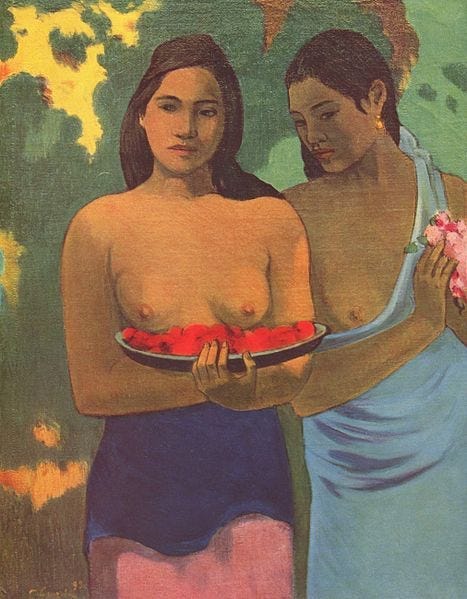

From painting to sculpture to photography to movies to music videos, women’s bodies have long inspired the art of men, but in so doing are often consumed and used like a product.
Though not gratuitous, Gustave Courbet’s The Painter’s Studio isn’t unlike a 19th-century strip club — sans child and dog and oil painting. One naked woman’s body services an odd crowd of fully clothed men in the room.
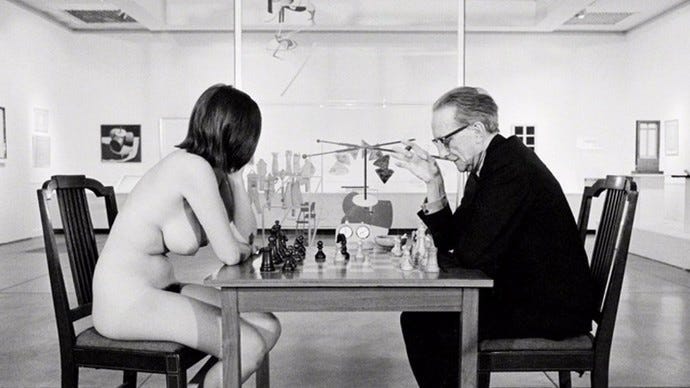
More than a hundred years later, even when the woman is depicted as able to interact with a fully clothed man as a chess-playing equal, she is still completely naked. In this famous photograph, we are the fully clothed onlookers while a completely naked Eve Babitz sits across from her elderly opponent. Sometimes she is parenthetically credited in the absurdly objectifying title: “Marcel Duchamp Playing Chess with a Nude, (Eve Babitz)”. A Nude. Not even The Nude. Note that in my description she is the subject of the sentence, but in Julian Wasser’s caption she is the object. And I suspect those parentheses were only added after she garnered her own acclaim as an author, though likely owing more to her ingenue infamy as an It Girl of the sexual revolution than to her literary prowess.
As is often the case with female nudity, her face isn’t even visible. But the face of the brilliant man is prominent.
Would a photograph of a fully clothed 76-year-old woman playing chess with a faceless naked 19-year-old It Boy be “brilliant” too?

Marcel Duchamp himself said the market value of art, the art coefficient, is “an arithmetic relationship between the unexpressed but intended and the unintentionally expressed.”
Even American female photographers default to female nudity as readymade, de facto art. Everyone lauds Annie Liebovitz for her groundbreaking and gender-role bending 1980 Rolling Stone cover with naked fetal John Lennon curled around fully clothed Yoko Ono. But I suspect most people would be as surprised as I was to read that this was not Liebovitz’s compositional brilliance or artistic direction but rather Ono’s last-minute refusal to strip for Liebovitz’s original vision of the nude lovers lying next to each other.
And so, dear art-loving friends, what are we to do? You don’t have to suffer through Nigel Cawthorne’s “Sex Lives of the Great Artists” to know Gauguin’s commodification and consumption of girls and women was the rule, not the exception. He believed, like Modigliani that it was impossible to paint or sculpt nude women without also sleeping with them.
And after researching 25 male artists, their depravity, and their abuse of girls, boys, women, and men, Cawthorne’s own revolting conclusion was that he had chosen the wrong vocation as an author, that he too should’ve become an artist so that he could tell women, “Take your clothes off, baby. I’m an artist.”
The female body is indeed beautiful. It merits celebrating in art. But the market in which it’s being sold always requires examining. Is the artist/musician/producer the only one profiting from the depiction of a naked woman? Is posing/dancing/playing chess nude a woman’s best option for financial independence and success?
Art reflects the very gendered economic disparity caused by social inequality. Until both are resolved, we must also be critical of the art we consume because it continues to sexualize and disenfranchise women.
We can start by promoting female artists, who, like women in every industry and field except sex and caregiving, are devastatingly disproportionately underrepresented.
There is a footnote to Gauguin that sharpens your point rather than softening it. He is widely believed to have had syphilis - and to have known it - while sleeping with more or less anyone within reach, including the teenage "wives" the film romanticizes. He was hospitalized repeatedly in Papeete, categorized among the venereal patients, and spent his last years with the suppurating leg sores that he and his contemporaries treated as syphilitic. (A 2018 analysis of his teeth found no mercury, the standard treatment of the era, so some scholars now hedge on the diagnosis. His behaviour needs no hedging.)
The paradox: his grandmother was Flora Tristan, the French-Peruvian socialist who argued in 1843 - five years before the Communist Manifesto - that workers' emancipation was impossible without women's emancipation. She is largely forgotten. Her grandson, who consumed women as raw material, is canon. Even Vargas Llosa, who novelized both grandmother and grandson in The Way to Paradise, built his double portrait on exactly this inversion: her utopia was collective, his was for one.
That asymmetry is not a coincidence. It is the pattern itself: the man who exploits is remembered, the woman who understood is erased.