
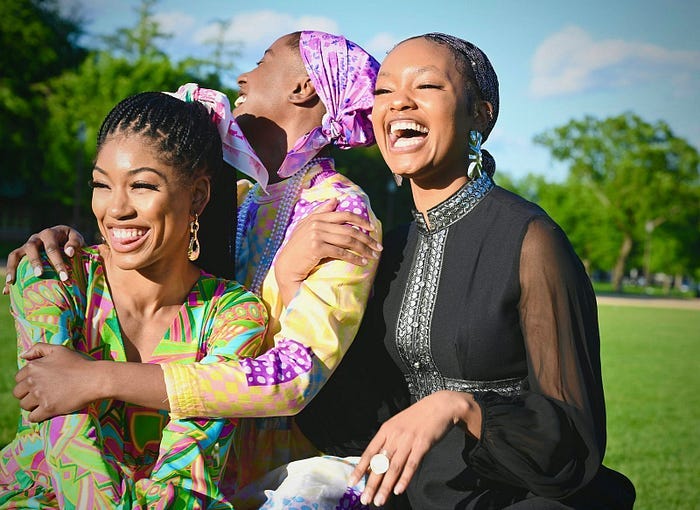
Sometimes the internet really is a global community center with curious, open-minded people learning from each other.
While the MAGA administration was wasting our taxpayer funding on a massive custom-built octagon, a UFC spectacle to celebrate our 250th anniversary as an independent nation, a local library recommended books for its “We the People” series. The stories are as multicultural as this country is.
I wrote an article about how the diversity of their book recommendations better reflects the vast diversity of this country than the white Christian nationalism too many Americans espouse. One response surprised me.
“Out of curiosity: what is the definition of ‘Black joy’? That would make it easier to find relevant material.”
Thank you for asking, dear reader. But a white person is not the right person to answer this great question.
Isn’t it wonderful that they asked, though? Isn’t that the value of online communities where we actually exchange information and learn from each other instead of virtually attacking strangers in the comment sections?
So, what is Black joy? Let’s ask those with lived experience who promote the idea, practice, and movement of mainstreaming and celebrating Black joy. Then we’ll ask Black writers, readers, and librarians for their book recommendations.
Since a white writer is not the right person to define Black joy or recommend specific books about Black joy, this is largely a quote-heavy list of resources more than an article. As it should be.
Additional definitions, recommendations, and resources are welcome.
What Is Black Joy?
I debated whether or not to write this. I do not have the answers. But I can do the research. I can take the time to read what Black people write about it. And we can learn from the experience and expertise they have taken the time to share with readers. This is an investment in better understanding more people.
Let’s listen.
“At the heart of the Black Joy movement is what many scholars, journalists, authors, and others are describing as resistance, resilience, and reclamation of Black Humanity. Life brings everyone challenges, disappointments, losses, and unexpected difficulties, regardless of race,” the National Museum of African American History and Culture says.
“But when race is added to the mix, the situation is compounded exponentially. When people live in a world that devalues them because they are black or brown as well as dismisses their contributions to the larger society, Black Joy is and has been an effective tool that has allowed individuals and groups to shift the impact of negative narratives and events in their favor,” the NMAAHC explains.
The museum further quotes Kleaver Cruz, the Black, queer, Dominican-American founder of The Black Joy Project, “a digital and real-world affirmation that Black joy is resistance,” who works and presents about this movement across the African diaspora.
“Black Joy is not … dismissing or creating an ‘alternate’ black narrative that ignores the realities of our collective pain; rather, it is about holding the pain and injustice…in tension with the joy we experience,” Kleaver Cruz explains. “It’s about using that joy as an entry into understanding the oppressive forces we navigate through as a means to imagine and create a world free of them.”
Pain, joy, and resistance are not just American experiences.
“We can actively trace the spatial and temporal control of Black expression from slavery and colonialism through to today,” award-winning journalist and producer Chanté Joseph wrote of the UK government’s attempts to criminalize Black Lives Matter protestors in 2020. “This is why the act of joy is resistance and as we use our physical bodies to protest, march and demand change, we must also use them to experience the pleasure of joy.”
Joseph is the founder of Strangers in the City, an ambitious events platform trying to tackle the growing loneliness in a globalized world where so many people still live very isolated lives. She writes with the same compassion she works with.
“For Black folks, joy and resistance aren’t really that separate. The reason that joy and resistance pair so well is because as Black folks, we have been resisting all our lives,” Black Joy and Resistance photographer and author Adreinne Waheed told Joseph in her British Vogue article. “Ever since we were brought to the US and enslaved, our lives have been subjugated and our freedoms have been regulated.”
Joseph points out that Black joy can be informal too. She references Kaylaa Robinson’s video series Thread: Videos of Black People Laughing. Even though it’s a brief carousel, it will make you smile. Immediately. And it reminded me of the “Black Men Frolic” trend on social media. Black men all over the internet filmed themselves running through fields, smiling, laughing, and lying down in wildflowers. They were giddy. They were touching grass before “touching grass” became slang. How often do we see men letting themselves enjoy whimsy, let alone Black men? Their frolicking made me grievously regret not bookmarking the photographer who did a portrait series of Black men smiling. Dear reader, do you know the name of that photographer or have a link to that beautiful series? Please share it. Not only is it gorgeous art with striking composition, it is a sociopolitical gut punch when you contrast it with how the media primarily depict Black men across platforms and genres.
Black joy is a critical component of a more comprehensive story. But Hollywood, the media, and the American government almost singularly depict Black people as innately criminal or victims of their own criminality. And it is well-documented that the news and the government depict Black people as criminals, even when they are the victims of crime.
Hollywood rarely portrays Black people with nuanced complexity or full humanity. But it will market their trauma for profit while our government minimizes, denies, and perpetuates it.
Stories about Black joy showcase the nuanced fullness of humanity.
Books About Black Joy
Now that we’ve read a little bit about what Black joy is, what it does, and why it matters, what books do Black readers, writers, and librarians recommend?
Multnomah County Library manager Kirby McCurtis says that books like “White Fragility” and “How to Be an Anti-Racist” are “a great place to start” when you’re learning about white supremacy and racism. But she doesn’t want readers to stop there. McCurtis told OPB listeners it’s important to include Black fiction and stories about Black joy when building your own anti-racist reading list.
When OPB interviewed McCurtis during the pandemic, they also quoted novelist Jasmine Guillory: “Racism is not the only thing to know about what it means to be Black. Our joys, our sorrows, our love, our grief, our struggles to fit in, our families, our accomplishments, and our triumphs — these things also matter. Black children matter, and not only the ones killed before their time. You may think you already know that, but history has proved otherwise.”
In her Time magazine essay “Don’t Underestimate the Power of Black Fiction,” Guillory writes, “Multiple studies have shown that reading certain types of fiction increases a reader’s empathy for others in the world. Fiction gives you a window into both lives you know and recognize and ones you don’t.”
Award-winning writer Whitney Alese explains her recommended reading like this: “From the silly to the sustaining, from the hilarious to the hopeful, here is a collection of beautiful joyful Black books that are full of inspiring, uplifting, and encouraging books that you need to get to reading for a joyful Black History Month.”
Black Girl Nerds has seven recommendations for beach reads “to keep your summer going”. Journalist Delaina Dixon recommends these seven books from different genres that will all “lift your spirits.” Rich in Color specifically reviews and recommends YA books by BIPOC authors.
If you want to add Black authors in your favorite genre to your Black joy reading, google “Best Of” lists. Prioritize the lists curated by Black readers and Black writers.
Read more than one author. Read more than one story by the same author.
One of the most important things we’ve learned from world-renowned speaker and award-winning writer Chimamanda Ngozi Adichie is “The Danger of a Single Story.”
If we only expose ourselves to the extremes of Black trauma or inspiration porn, we flatten an enormously diverse group down to one dimension. Perpetuating stereotypes is reductive at best, and racist at worst.
Readers should be able to choose from beach reads, sci-fi, YA, mysteries, romance, fantasy, or whatever genre they love or want to explore more by Black authors.
In this Fahrenheit 2026 era of book banning and anti-DEI hate-mongering, it is as important as ever to read about the history of slavery in this country and the enslaved people who built our nation’s infrastructure, churches, and iconic landmarks. We need to teach students about all the ways enslaved people grew and sustained every sector of our early economy, and not just in the South.
Without centering white saviors, all students must learn about abolition, Reconstruction, segregation in the Jim Crow era, the Civil Rights movement, how the modern for-profit prison industry perpetuates slavery, enduring discrimination, systemic racism, white violence, weaponized whiteness, and police brutality and near impunity for hurting and killing unarmed Black people. Here is a staggering and heartbreaking crowd-sourced list attempting to name every unarmed Black person killed in the U.S. by a law enforcement officer, on or off-duty. It is so unconscionably long that it is organized by year.
But we also need books (and movies, and TV) featuring Black ingenuity, art, creativity, humor, laughter, fun, love, family, success, daily life, and joy.
Leave your recommendations below. What should grownups read? What should we read to children?
No one reader has all the answers, or the same answers. But options are a beautiful thing. And if we keep asking questions and seeking out the answers, if we keep reading, we’ll keep learning.
This article was originally published at Publishous